Your handicap narrows the options; your swing makes the final choice
- Swing speed. This helps narrow down which combinations of loft, weight and shaft are worth testing, particularly with the driver and longer clubs. Even so, swing speed alone does not determine the right set-up: strike pattern, launch, spin and dispersion also play an important role.
- Strike pattern. This is one of the factors that can have the greatest influence on a recommendation, and it is also one of the easiest to check: simply use impact tape or foot spray on the clubface during a practice session.
- Ball flight. Launch and spin explain why two players with the same swing speed can perform very differently. A flight that is too low with insufficient spin can produce excessive roll and limited stopping power, while a launch that is too high with excessive spin can reduce distance and make the ball more vulnerable to the wind.
- Dispersion. A club that gives you three extra metres but widens your misses to the left and right is not improving your game — it is only improving your best shot.
What players should prioritise according to their skill level
If you are still working on consistency
At this stage, the priority is usually to gain forgiveness and make it easier to launch the ball. Game-improvement iron heads, a wider sole, a low centre of gravity and a face that does not punish toe strikes too severely can all help.
The change that often makes the biggest difference at this stage is not replacing your irons, but taking out the long irons you rarely use.
If you struggle to launch your 4- and 5-irons consistently, a hybrid or fairway wood may be easier to play and help you produce a higher ball flight. The decision should be based on your actual results and on how those options fit into your distance gaps.
Two common points to bear in mind:
- A stiffer shaft does not automatically mean a better club. Choosing a stiff flex that does not suit your swing can alter launch, feel and dispersion. Flex should be chosen according to how the club performs for you, not because it is seen as a higher-level option.
- At this stage, there is no need to fill your bag simply for the sake of it. It is more useful to carry clubs that cover clearly defined distances than to add options that produce almost identical results.
If you want to see what is available across the different club categories before making a decision, the Golfriends golf clubs category is useful for getting your bearings, not for choosing blindly.
If you already play fairly regularly
For mid-handicap players, a more specific need usually emerges: maintaining enough forgiveness while gaining greater control over trajectory and dispersion. At this stage, aesthetics can play a role, but they should never outweigh how the club actually performs during testing.
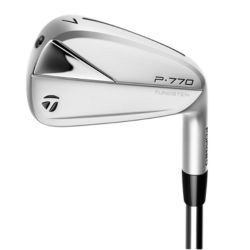
The aim is to find a head that provides ball speed, stability on off-centre strikes and a more compact look at address. Models such as the PING i540, Titleist T250 and TaylorMade P770 are three interesting options for achieving that balance of forgiveness, distance and control. The P770 moves further towards a compact, player-focused head for golfers who already strike the ball consistently, while the i540 and T250 offer a slightly more balanced combination of forgiveness and performance.
PING i540 vs Titleist T250 vs TaylorMade P770: three different approaches
PING i540: a balance of forgiveness and a compact head

Titleist T250: distance and stability without the look of an oversized iron

The Titleist T250 follows a similar philosophy, combining ball speed and forgiveness with a relatively compact profile. It can be particularly well suited to players looking for distance and stability without moving to a clubhead that looks overly large at address.
When choosing between the PING i540 and the Titleist T250, the decision should not be based on brand alone. The most useful approach is to compare which model delivers better results in terms of distance, trajectory and dispersion with the same swing.
TaylorMade P770: more suited to players with a consistent strike
The TaylorMade P770 moves further towards a more compact, player-oriented profile, where control and strike consistency become more important. It is particularly well suited to golfers who already find the centre of the face regularly and want a head that allows them to fine-tune feel, trajectory and distance control.
It can also work well as part of a combo set, using a more forgiving option in the long irons and the P770 in the mid and short irons. This type of set-up combines extra help where it is most needed with greater control in the scoring clubs.
So, which one should you choose?
None of the three is simply “better” than the others:
- If you are looking for more forgiveness without giving up a compact profile, I would start by testing the PING i540 and Titleist T250.
- If your strike is already fairly consistent and you prioritise control, I would include the TaylorMade P770 in the comparison.
- If you are choosing between all three, I would not decide based on handicap or on which one goes furthest on your best strike. I would focus primarily on average distance, peak height, dispersion and what happens when contact is not perfectly centred.
When your ball-striking is already refined
With a consistent strike, the conversation changes. It is no longer mainly about forgiveness; it becomes about control: distances that do not jump unexpectedly, spin that behaves consistently from the fairway and light rough, and enough feedback to tell where on the face the ball was struck.
This is also the type of player for whom a combo set makes the most sense: compact mid and short irons such as the TaylorMade P770, combined with something more forgiving in the long irons. There is no rule saying you have to play the same head from 4-iron through to pitching wedge.
At this level, fitting becomes even more important. Adjustments such as lie angle, length and shaft profile can have a significant effect on dispersion and consistency, often more than simply switching from one brand to another.
You do not build a golf bag one club at a time
The most expensive mistake is not choosing the wrong iron; it is buying clubs at different times and eventually ending up with two that cover essentially the same distance.
The check is simple and does not require a laboratory. Write down your average carry with your driver, fairway wood or hybrid, the longest iron you actually use and each of your wedges. If two clubs cover almost the same distance, one may be unnecessary. If there is a large gap between them, there may be room for another club in your set-up.
| Player profile | No. 1 priority | Sign that the club is NOT right for you | What to try |
|---|---|---|---|
| Strike pattern spread across the face | Forgiveness and easy launch | Your long iron only performs on a perfect strike | Game-improvement irons + a hybrid instead of the 4- and 5-irons |
| Centred strike but flat ball flight | Sufficient launch and spin | The ball lands and runs instead of stopping on the green | Adjust loft and shaft before changing the clubhead |
| Consistent strike, looking for control | Dispersion and repeatable distances | The gaps between irons vary from 5 to 15 metres | A combo set and measured gapping |
| You do not know your numbers | Measure before you buy | You choose based on brand or handicap range | A measurement session and comparative testing |
The putter is also part of how you configure your golf bag, but choosing one involves different criteria from selecting irons. If you are still unsure, you can consult our guide on how to choose a putter based on length, lie and head type.
The same applies to the top end of the bag, where the choice is often between a driver, 3-wood or hybrid.
Complete set or individual clubs?
Not every golfer needs to replace their entire set at the same time. A complete set can make sense when you are starting out or when your current equipment no longer suits your level, but if several clubs are still performing well, it is better to identify where the problems actually are first.
You might keep a set of irons that gives you reliable distances and only replace the longer clubs, review your wedges if there are significant gaps, or change your driver and fairway wood if dispersion is costing you shots from the tee. The key is to improve a specific area of performance, rather than replacing equipment simply because it belongs to an older generation.
What to Try First Based on How You Play Today
If you are still building a consistent swing, start by reviewing your longer clubs. If you struggle to launch your long irons consistently, try hybrids or fairway woods and compare the results. Prioritise a simple set-up, with clear distance gaps and shafts that allow you to make your natural swing.
If you play regularly and want to keep improving, do not replace all fourteen clubs at once. Measure your actual distances and the gaps between clubs, review the lofts of the set you are considering, and then decide where the real problem lies.
If your ball striking is already consistent, the gains are in the details: a combo set, lie angle, length and a proper comparison of dispersion, rather than simply focusing on the longest shot of the day.
And if, after reading this, you are not sure which group you fall into, that is exactly why a fitting session exists: measure first, buy second.