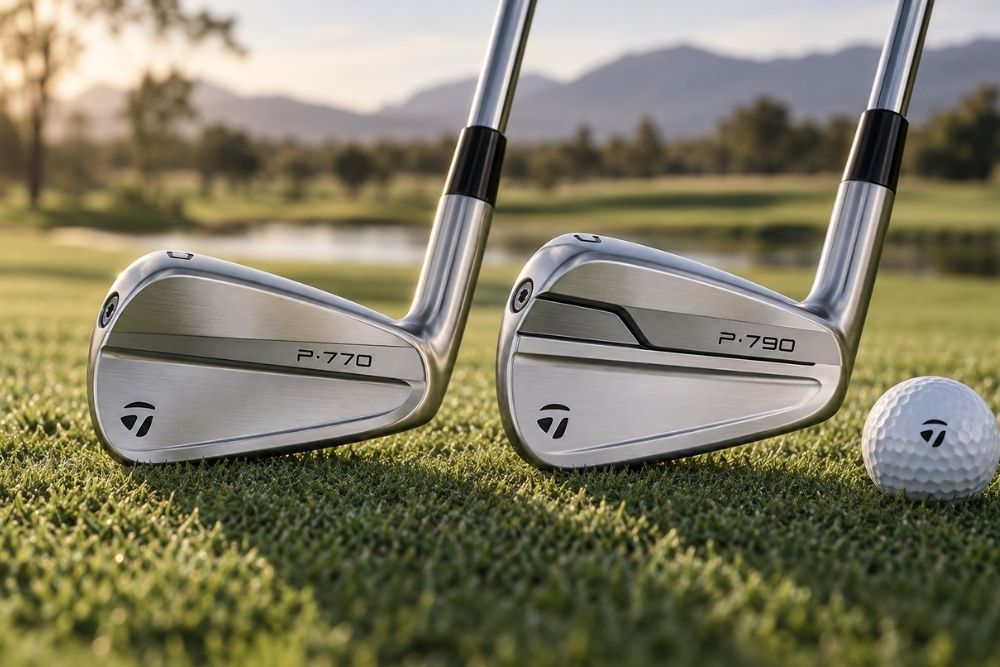
TaylorMade P770 vs P790 is a comparison that starts before you even hit a shot. At address, the P790 presents a slightly larger head, while the P770 looks more compact, with a thinner topline and a shape closer to that of a player’s iron.
That visual difference sums up the approach of each model quite well. From there, choosing between the P770 and P790 comes down to the ball flight you are looking for, the level of forgiveness you need and the feedback you want from each strike.
| Model | Try it first if… |
|---|---|
| P770 | Your strike is already reasonably consistent and you prioritise trajectory control, feel and a compact head that gives you clear feedback on where you struck the ball. |
| P790 | You are looking for ball speed and a little more forgiveness on off-centre strikes without giving up the look of a premium iron. |
| Combo | You struggle with the long irons but control the short irons well: P790 at the top of the set and P770 at the bottom, provided the gapping works properly. |
The First Difference: How They Look at Address
Visual confidence is not a minor detail. If a compact head makes you feel that you have to strike the ball perfectly, you are probably not benefiting from that look, however appealing it may be.
The TaylorMade P770 is the more compact of the two within TaylorMade’s range: it has a thinner topline, a shorter blade length and less offset, particularly in the long irons.
The TaylorMade P790 has slightly more presence behind the ball and gives a more reassuring look at address.
Offset also forms part of that visual impression. More offset can help certain players feel more comfortable squaring the face, while less offset creates a cleaner look and often appeals to golfers who prefer a more compact appearance. Neither is better or worse: it depends on what gives you confidence at address.
It is also worth remembering that the P770 and P790 have gone through several generations, and they do not all perform in exactly the same way. The specifications from an older comparison may not describe the current models, so always check which generation you are testing.
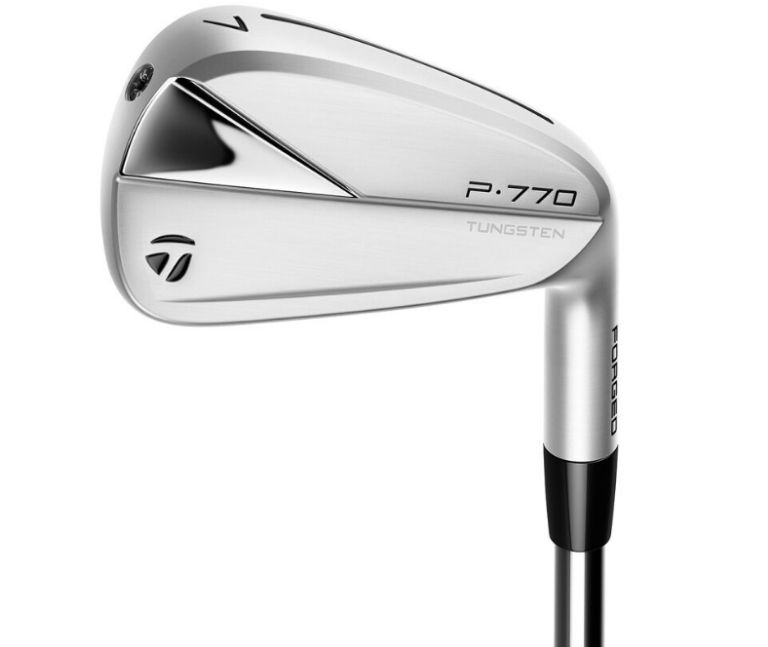
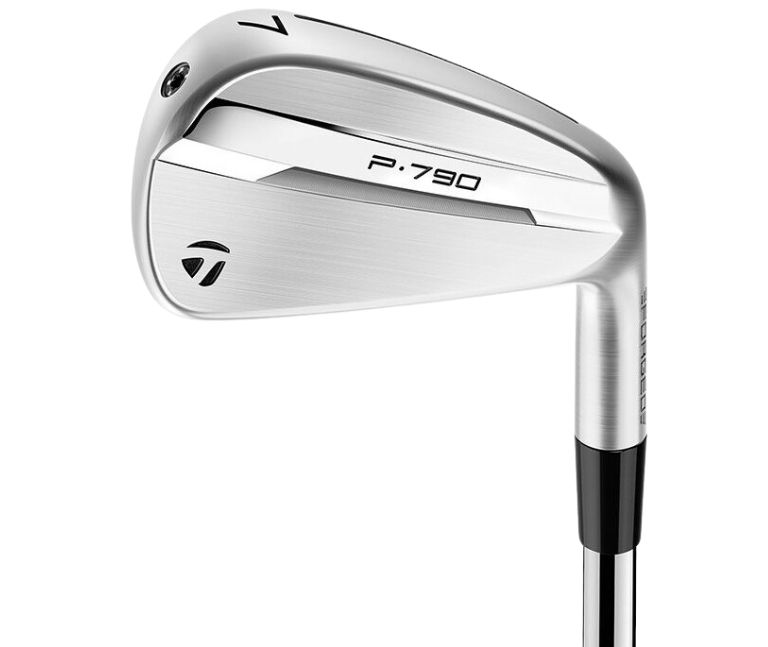
TaylorMade P770 vs P790: The Specifications That Really Matter
| 7-Iron | P770 | P790 |
|---|---|---|
| Loft | 33° | 30° |
| Length | 37" | 37" |
| Construction and internal weighting | Forged hollow-body construction, thin face and FLTD CG | Hollow-body construction, forged 4340M face, SpeedFoam Air and FLTD CG |
Without that table filled in for the specific generation you are comparing, any conclusion about distance is incomplete. Two irons with several degrees of loft difference can produce different numbers even if the heads follow a broadly similar design philosophy.
The Shaft Can Change the Comparison More Than You Might Think
Comparing two heads with very different shafts can lead you to attribute certain behaviour to the P770 or P790 when, in reality, it comes from the overall build.
The shaft weight, bend profile and length can all affect how the club loads, strike location and launch window. If the P790 is fitted with a lighter shaft and the P770 with a heavier one, you are not comparing the heads alone.
Wherever possible, test equivalent set-ups or, at the very least, make a note of which shaft is fitted to each iron. If both the head and shaft change at the same time, interpret the results as a comparison of complete set-ups, rather than an isolated P770-versus-P790 head test.
Loft and Distance: The Mistake of Looking Only at the Metres
If the P790 flies further than the P770 with your swing, the first question to ask is how much of that difference comes from loft and club length, and how much comes from the construction.
There is a second question that matters even more on the course: does the ball stop where it needs to? An iron that gains distance but arrives with a descent angle that is too shallow or with too little spin can make approach shots more difficult, even if the carry looks impressive on the practice ground.
Always compare the entire ball-flight window — peak height, descent angle and spin — alongside carry. An iron that reaches the target in a more controllable way may be more valuable than one that simply flies further.
When You Don’t Strike the Centre
This is where the two designs really begin to separate. Any premium iron can produce excellent results from a centred strike; the difference shows up on heel strikes, toe strikes or contact slightly low on the face.
The useful question in a fitting is not which club produces the best shot, but which one loses less performance on your typical misses. If your strike pattern is spread across the face, the extra forgiveness of the P790 may help retain carry and keep dispersion under better control. If your strike pattern is tighter, that extra margin may matter less and the feedback from the P770 may become more important.
On the launch monitor, pay particular attention to two figures: how much ball speed each iron retains when you miss the centre, and how much carry drops compared with your better strikes. That is where a difference can emerge that you may then notice on the course.
Feel: “Forged” Does Not Automatically Mean Better Feel
Both models use advanced constructions, and the final feel depends on much more than the word “forged”: head design, internal materials, face construction, sound and the overall set-up.
Do not buy based solely on what is stamped on the clubhead. Hit several balls with each model and pay attention to what feedback you receive on both good and poor strikes. Some players want to feel clearly where they missed the face; others prefer a more consistent sensation.
It is a perfectly valid factor to consider, but it should come after checking that the numbers also work for your game.
Does a Combo Set Make Sense?
Yes. For some players, it can be a particularly effective set-up: P790 in the long irons, where the extra help may be more useful, and P770 in the shorter end of the set, where control becomes more important.
The key is making sure the gapping works at the transition point. If the crossover clubs from each model have lofts or carry distances that are too similar, you may end up with two irons covering virtually the same distance. If the gap is too large, you will create a hole in an important part of the bag.
The transition point can vary from one player to another. Rather than choosing it for the sake of symmetry, it is better to place it where your control zone begins. If the 7-iron is the club from which you start attacking flags with confidence, it may make sense for the more compact model to begin there.
When Neither the P770 nor P790 May Be the Right Choice
P770 and P790 are aimed at different player profiles, but neither is necessarily the best answer for everyone.
If you still lose too much carry on off-centre strikes with the P790, or you clearly need more help launching the ball, it may make more sense to test a more forgiving head rather than force the choice between these two models.
At the other end of the spectrum, if you are looking for an even more compact head, with less assistance and a more direct response at impact, there may also be options within the players’ iron category that suit you better.
This comparison is useful for choosing between the P770 and P790 when both produce a workable ball-flight window. If either one — or both — forces you to compensate with your swing, the best option may lie outside this head-to-head comparison.
P770 or P790: Decide Based on the Shot You Want to See
The test that settles this comparison does not need to be a long one. Start by hitting several balls with each 7-iron and avoid making your decision based on maximum carry. Compare the entire ball-flight window: peak height, descent angle, spin, carry and dispersion.
Then ask yourself three questions:
- Which one consistently leaves the ball closer to the target?
- Which one loses less performance when you miss the centre?
- Which one makes you feel more comfortable at address?
If all three answers point to the same iron, the decision will be straightforward. If they are split, a fitting with comparable set-ups can help you determine which option works better with your swing.
And if you are also rethinking the rest of your bag, our guide on which golf clubs to choose for your skill level expands the comparison to the rest of the set.