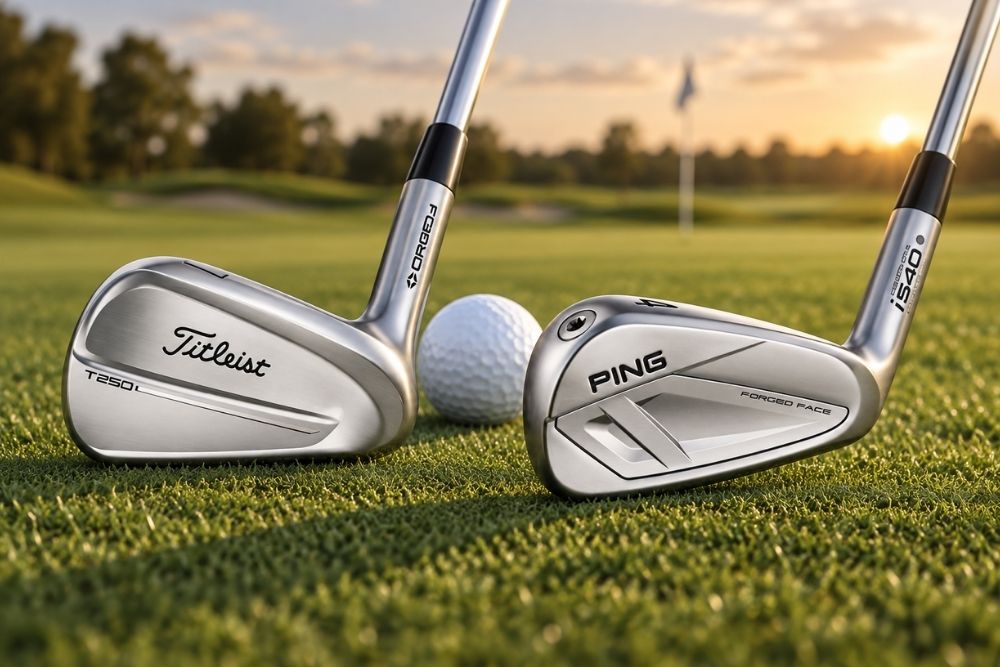
PING i540 vs Titleist T250 is a comparison best decided with data rather than brand preference. Carry, peak height, descent angle, dispersion and performance on off-centre strikes are the metrics that really separate the two irons.
The key is to determine which one produces a more useful and repeatable ball flight with your swing, particularly when contact is less than perfect. From there, we will look at the differences between each model and which type of player may be better suited to one or the other.
Two Players-Distance Irons That Solve the Same Problem in Different Ways
The players-distance category is designed for golfers who want a relatively compact head without giving up ball speed or a degree of help on less-centred strikes. That is why these irons often use hollow or semi-hollow constructions, thin faces and internal weighting designed to make launch easier.
Within this category, PING and Titleist follow slightly different philosophies. PING tends to prioritise stability and consistency in the ball-flight window, while Titleist places more emphasis on trajectory control and a coherent progression throughout the set.
Even so, the apparent size of the head is not enough to predict how it will perform. Two irons that look similar at address can produce different ball flights depending on how the mass is distributed and how the lofts are configured.
The Specifications Worth Comparing Side by Side
| 7-Iron | PING i540 | Titleist T250 |
|---|---|---|
| Loft | 29° | 30.5° |
| Length | 37" | 37" |
| Construction and internal weighting | Forged maraging-steel face, tungsten sole weight and inR-Air technology | High-strength steel construction, forged V-Taper L-Face, Max Impact and split high-density tungsten weighting |
| Shaft for a valid comparison | Same model, weight and flex as the T250, or an equivalent set-up | Same model, weight and flex as the i540, or an equivalent set-up |
One point that almost everyone overlooks: if the lofts are not the same, the distance difference between the two stops being particularly useful information. And if the shafts differ in weight or profile, part of what you see on the launch monitor will be coming from the set-up rather than the head itself.
PING i540 and Titleist T250: What Each Model Is Designed to Deliver
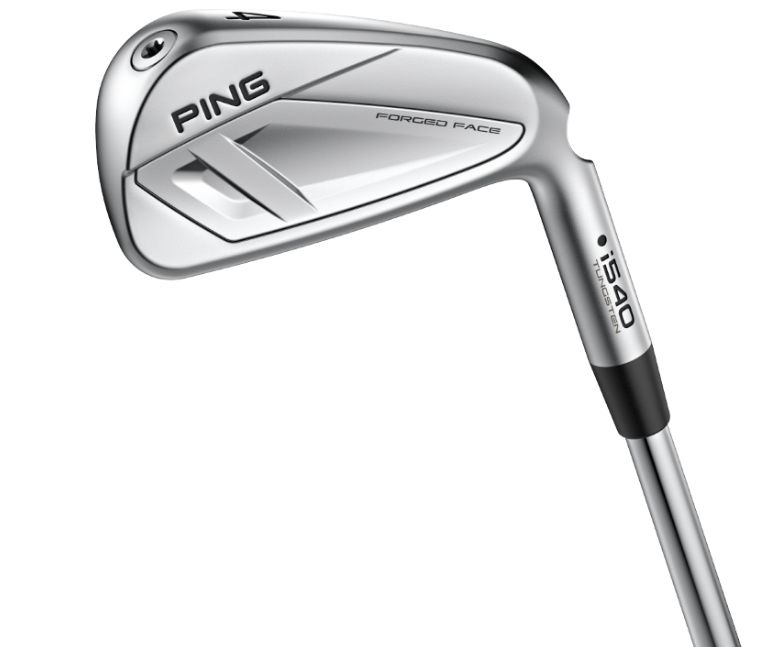
PING i540
PING builds the i family around a fairly recognisable idea: high ball speed with a ball-flight window that repeats shot after shot, combined with a head that performs well on off-centre strikes without looking like a game-improvement iron.
For the player, that usually translates into a stable and predictable ball flight, which is exactly what you need when choosing a club for an approach to the flag. The specific details of face construction, internal weighting and fitting options should be taken from PING’s official specifications, rather than from claims repeated on forums.
Titleist T250
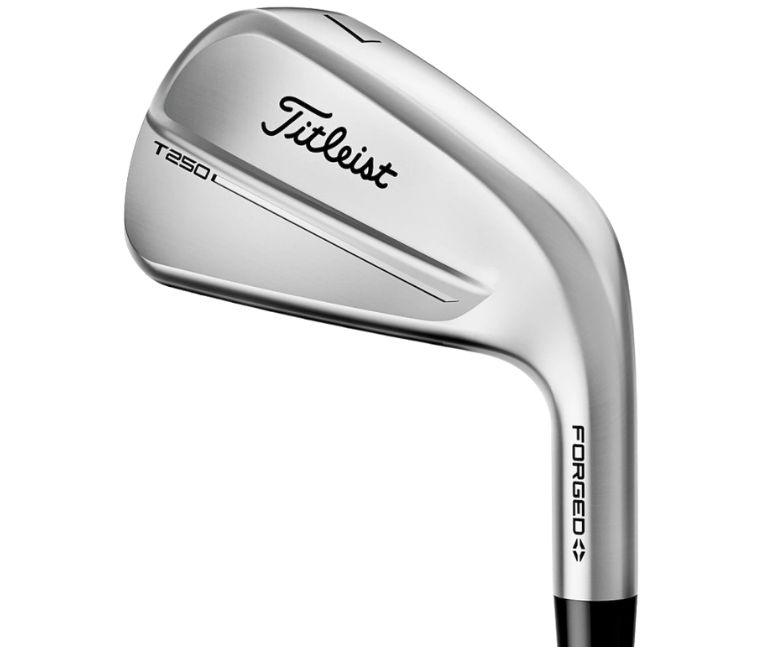
Titleist’s T-Series is designed as an ecosystem: irons that can be blended together so the player can build a set with more help at the top end and greater control in the shorter irons. The T250 sits in the part of the range that combines speed with a still relatively compact profile.
Its usual argument is progression: the 4-iron does not necessarily need to behave according to the same design logic as the 9-iron, and the set is built around that idea. As with the previous example, any specific figures should come from the current official specifications.
If you want to see the available builds and compare specifications before stepping into the fitting bay, you can find the PING i540 and Titleist T250 in the shop.
The Gapping Across the Full Set Matters Too
Although the first comparison may be made with the 7-iron, the decision does not end there. Before choosing, it is worth checking how the lofts and distances fit together throughout the rest of the set, particularly in the transition into the long irons and down towards the pitching wedge.
Two irons can produce very similar results with the 7-iron and still create different distance gaps elsewhere in the bag. What matters is that each club covers a useful and repeatable distance, without overlaps or gaps that you then have to compensate for by changing your swing.
The Test That Should Break the Tie
Without a controlled test between the two models, there is no real basis for declaring an overall winner. So here is the protocol we would use, and the one you should expect from any serious fitting:
- The same iron from both sets, preferably the 7-iron.
- The same ball and the same player, in the same session.
- Shaft details recorded: model, weight and flex for each club.
- Between five and eight valid strikes with each club, using a clearly explained exclusion criterion applied equally to both.
- Compare medians and dispersion, never the best shot.
There is also one variable that can invalidate the entire test: the shaft. A significant difference in shaft weight can alter tempo, strike location and, as a result, peak height and spin. If the stock builds are not equivalent, either test both with the same shaft or accept that part of the result is coming from the build rather than the head. If there is no way to match them, at least record the difference: it is what separates a proper comparison from an anecdote.
The metrics that matter are carry, spin, peak height, descent angle and lateral dispersion. If one iron gains carry but arrives on a flatter trajectory with insufficient spin, it is not necessarily performing better: it is trading distance for stopping power.
Don’t Choose the Entire Set Based on Testing Just One Iron
The 7-iron is an excellent reference point when comparing two models, but before buying the full set it is worth adding at least one long iron and one short iron to the test.
That allows you to check whether the help you notice in the middle of the set is still there where you need it most, and whether the short irons continue to deliver the trajectory and control you are looking for. With progressively designed sets, this check can even change the point at which a combo set starts to make sense.
Which Player Should Try Each One First
Start with the i540 if your priority is for the ball to fly at a consistent height and you want some extra margin on strikes that miss the centre of the face. It is a good starting point when consistency in the ball-flight window matters more to you than fine-tuning every trajectory.
Start with the T250 if you are interested in building a progressive set, blending it with other models from the T-Series depending on the part of the bag, or if you are looking for slightly finer trajectory control in the short irons.
And if you are still unsure, the question that should guide the decision is not your handicap: it is which type of miss you make most often and which of the two handles it better.
What the Test Between the PING i540 and Titleist T250 Should Decide
After testing both irons, do not focus only on which one produced the best shot. What matters is determining which model delivers the result you need on the course more consistently.
Pay particular attention to four things: which iron produces the tighter grouping, which maintains a trajectory that allows the ball to stop on the green, which is less punishing on your typical misses, and which one gives you greater confidence at address.
If one of the two stands out clearly in most of those areas, you probably have your answer. If the difference remains small, a test with equivalent set-ups can help isolate the effects of the shaft, fitting adjustments and the clubhead itself.
And if this decision forms part of a broader review of your bag, our guide on which golf clubs to choose for your game will help you work these irons into the rest of your set.